
A communications plan has a few purposes:
- It helps the stakeholders and sponsors of the project understand and align with the communications approach and actions.
- It provides a touchpoint for the communications team to ensure all messages related to the project are cohesive and consistent.
- It serves as a working document to track the execution of the plan.
Introduction
The Introduction slide sets the context for the communications plan by describing the project the plan will support. This may be an event, such as a business conference; an initiative, such as a new strategy; or a pressing business issue, such as a need to improve customer service.

You can use this page to describe the reasons it’s important to have a communications plan: for example, the importance, scope and/or complexity of the project and the types of communications required to support it.
You may also want to use the introduction slide to provide some background information about the project – or, you may want to create a separate slide for the background information if it’s lengthy.
Goals
Use the Goals page to describe what a successful outcome for this communications plan looks like, sounds like, and feels like. Note that these goals should be specific to the communications, not the project itself, and should be specific, objective, quantifiable and measurable.

Challenges
You cannot achieve successful communications unless you are clear about the challenges you will face. And a key role of the communications function is to help create transparency around initiatives and issues the organization faces.

For some projects, the challenges will be clear. For others, it may be wise to do some intake with people across your organization to find out what people know (or don’t know), think or feel about the initiative or issue. This can be done via a formal survey, focus groups, or informal conversations, depending on the project.
Approach & Objectives
Describe your approach for communicating about the project, event, initiative or issue. Will you start slow and lead up to a “big reveal”? Will you begin with a major announcement and follow up with reinforcing messages? Will this be a high-energy, multi-media campaign? Describe how this approach meets the objectives required to achieve your goals, and overcome any potential challenges.

Key Messages
Create a short list of 3-5 key messages that all communications about this project should promote – too many key messages creates confusion; too few become tedious.

Key messages are important for a number of reasons:
- Key messages are touchpoints to the goals and objectives of the communications plan
- Summarizing key message makes it easy for communicators to craft their own messages as needed
- Key messages help to ensure cohesive communications across the organization
- Articulating the key messages ensures consistent language is used
- Repetition of key messages helps drive understanding and clarity
Stakeholder Matrix
Use the Stakeholder Matrix to consider the various stakeholder groups to which you will need to communicate. This will help to ensure your messages have the greatest impact.

- What is the purpose of the communication to each group? For instance, do you need this group’s alignment or support? Will the communication be for informational purposes only, or is there some action you need this group to take? Groups may have more than one communications purpose.
- For each group, what should they know about the project? How should they feel? What should they do?
- Finally, what form(s) of media will you use for this group?
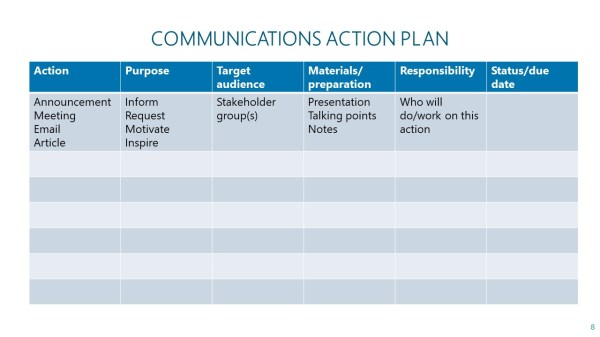
Communications Action Plan
The Communications Action Plan is where you plan and track the specific actions required to execute the plan. This section will be the working portion of this plan and should be updated frequently.
Appendix
Additional information you may want to add to your communications plan:
- Templates: Message templates for use by the team and others.
- Message examples: Include examples of messages, such as email announcements, that have been used as part of the plan. They serve as a reference and may be reused if needed.
- Benchmarks and milestones: To measure progress and celebrate success.

As your plan progresses and evolves, you should review and update, reevaluating your goals, approach, objectives, and challenges – and make course corrections as needed. Capture these learnings so that you can apply them and create even more successful plans as you grow in the Internal Communications role.
 Communicating Authentically
Leave a comment