
Shakespeare’s Mind for the Future Brings Marketing Success
“What is past is prologue.”
~ William Shakespeare, The Tempest
Some business professionals might assume William Shakespeare’s words to be anachronistic, having more interest to historians than relevance to today’s complex and uncertain business environment.
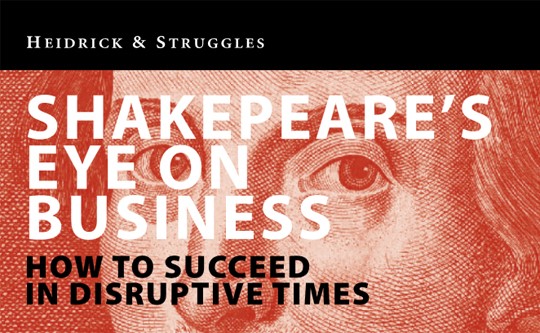
Heidrick & Struggle’s Shakespeare’s Mind for the Future campaign, which recently won the first place award for Best Campaign by a Company at the Asia Pacific Communications Awards in Singapore, would prove them wrong.
Sponsored by the Asia-Pacific Association of Communications Directors (APACD), the APAC Communications Awards recognize outstanding achievements and innovative strategies from the world of public relations and corporate communications. Our entry, comprised of a series of articles comparing leadership examples from Shakespearean plays to elements of leadership today, received the highest score for creativity and innovation in preliminary judging, advancing Heidrick to the finals. From there, history was on our side, and the relevance of the Bard’s wisdom helped secure a Heidrick win against two formidable foes: Microsoft Asia Pacific and Western Union.
Four hundred years ago, William Shakespeare revealed the human foibles that create failure, and the transformative formulas that deliver success. Many of his works illustrate that authoritarian leadership fails in times of disruptive change; that the power to change lies not in armies or titles, but in winning hearts and minds.
Just over one year ago, our team had the idea of looking to Shakespeare’s writing for insights into current issues like disruptive leadership, corporate culture and top-team effectiveness. Of the presentation to the APACD jury panel, a team member recalls, “About five minutes into our 10-minute presentation I felt that we had really hooked them with our storytelling about Shakespeare’s characters and leadership. They really became engaged with the presentation, and they confirmed this at the awards dinner by saying they were immediately intrigued about our idea and were keen to learn more. This campaign gives us opportunities for further conversations with leaders in the region.”
The Shakespeare’s Mind for the Future campaign examines 16th-century England—a time of economic upheaval, paradigm shifts in business, social inequality and terrorism; themes painfully familiar to any 21st century observer—as reflected in the plays of William Shakespeare. This body of work, coinciding with the 400th Anniversary of Shakespeare’s death in 1616, asks: Are we making the same mistakes today, and, if so, what can we learn (and do differently) to improve the outcome?

One article in the series, Shakespeare’s Mind for the Future: A Modern-Day Tale, features “A Leadership Lesson in Three Acts” laid out as follows:
- Act I — 1616/2016: Then Is Now : David Pumphrey reflects on leadership styles of the rulers who dominate some of William Shakespeare’s most successful plays, and their relevance to today’s leaders: Richard II’s “divine right to rule”; Henry IV’s “autocratic leader”; and “people’s hero” Henry V.
- Act II — The Shakespeare We Don’t Know: Business Genius and Disruptor : James Shapiro, Professor of English and Comparative Literature at Columbia University, examines how Shakespeare himself exhibited many innovative behaviors of a modern entrepreneur by creating a yet unheard of joint-stock company; by encouraging inclusiveness and diversity; and in the process, generating wealth for himself and his colleagues while mitigating operational risk and personal harm.
- Act III — John Bell: Leadership lessons from the performing arts : The founder of Bell Shakespeare talks about Shakespeare’s leadership and the relevance of leadership in the performing arts to the corporate world.
- Epilogue : speeches and commentary

In another article, “Where Caesar Went Wrong: Anatomy of a Boardroom Coup,” David Pumphrey compares Shakespeare’s play Julius Caesar to what takes place within a dysfunctional board today. Caesar is compared to the Chairman; Brutus the Managing Director; Cassius the Chief Operating Officer; and Mark Antony and Octavius as two other directors. The implication is that regardless of the time period, dysfunction plagues a board that pursues its own agendas rather than operating as a team.
In addition to the APAC Communications Award, the campaign continues to gain momentum and create new business opportunities along the way:
- Articles from the campaign have been featured in traditional media including Management Today, BOSS Magazine and The Deal, and shared via LinkedIn and Twitter.
- We’ve hosted several client events across three continents: client dinners in Sydney and Melbourne; C-suite client dinners with John Bell of the Bell Shakespeare Company in Hong Kong, Singapore and Shanghai; and 95 executives attended an “Anatomy of a Boardroom Coup” event shaped around the play Julius Caesar in Mexico City this past September.
- Our full-page advertisements in theater programs—from the Royal Shakespeare Company’s home at Stratford-on-Avon, to Shakespeare companies in London, Chicago and Dallas—are reinforced by online ads on Playbill websites in the US and on banners that will run in the business section of The Wall Street Journal Asia over the next two months.
- The five articles in the Shakespeare series—The Shakespeare We Don’t Know: Business Genius and Disruptor, What Shakespeare Can Tell CEOs about Leadership in Disruptive Times, Shakespeare’s Mind for the Future: A Modern-Day Tale, Where Caesar Went Wrong: Anatomy of a Boardroom Coup, and Leadership Lessons from the Performing Arts—have earned nearly 15,000 new and unique visitors to Heidrick.com.
We encourage you to help build momentum for this successful campaign by sharing this link to Shakespeare’s Eye on Business: How to Succeed in Disruptive Times via your personal brand on LinkedIn and other social channels. We suggest the following script to start the conversation: “Was Shakespeare a pioneer in leadership strategy? The wisdom of the late author resonates 400 years after his death and provides transformative lessons for executives in a highly disruptive business world.“
Congratulations to the team for a successful campaign, and the many great ideas that continue to be born in APAC.
“Things won are done; joy’s soul lies in the doing.”
~William Shakespeare, Troilis and Cressida
 Communicating Authentically
Leave a comment